We Take Swimming Seriously. Children Shouldn’t Have To.
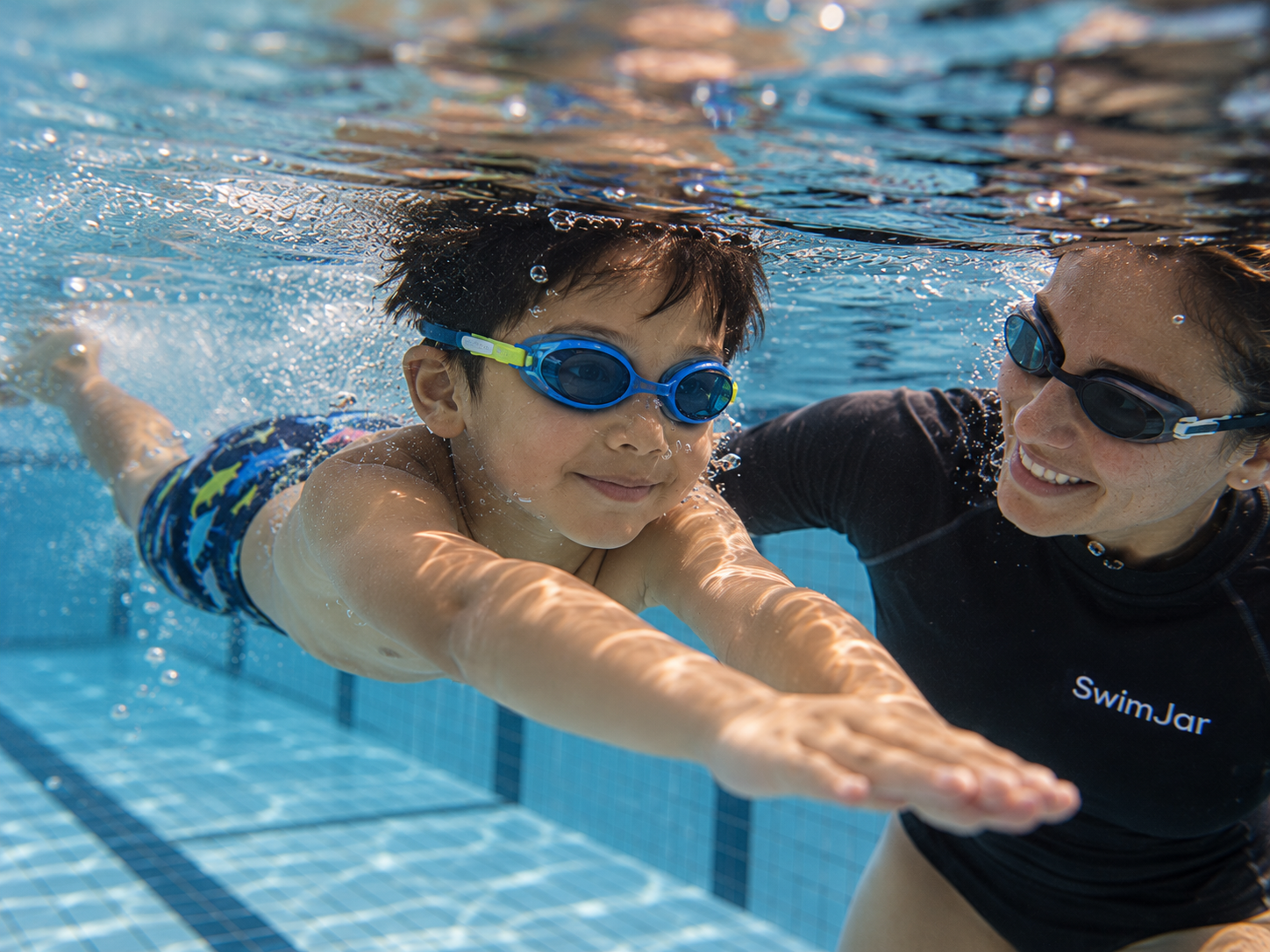
child-learning-to-swim-naturally-swimjar.jpg
Watch a good children's swimming lesson and, occasionally, very little seems to be happening.
A child glides through the water. Turns onto their back. Tries something again. There may be a short instruction, a laugh and another attempt. From the side of the pool, it can look simple.
It isn't.
Beneath that apparently simple movement, a child may be learning balance, breath control, coordination, body position and something much harder to teach: how the water feels. The child doesn't need to know all of that. The teacher does. This is the thinking behind SwimJar. We take swimming seriously so that, for children, learning can feel natural.
What are you actually paying for in a swimming lesson?
It is a reasonable question.
London has no shortage of children's swimming lessons. There are large swimming schools, leisure-centre programmes, small groups, private teachers and intensive courses. Many will teach children to swim lengths and progress through recognised stages. So the difference isn't simply that one lesson takes place in a swimming pool and another does too. The real difference is often in what the teacher sees. Two children can complete exactly the same length while needing completely different teaching. One may be working far too hard because their body position is creating resistance. Another may have good natural balance but lose it every time they breathe. A third may understand the movement but not yet have the coordination or strength to reproduce it consistently. From the viewing area, all three may simply look as though they are learning front crawl. To an experienced eye, they are three different swimmers.
And they need three different responses. That ability to observe, understand and adapt is a significant part of what parents are paying for when they choose specialist teaching.
We don't wait until later to teach children well
There is an idea in swimming that technique becomes important once a child is more advanced. At SwimJar, we see good technique as part of learning from the beginning. That doesn't mean giving a six-year-old a lecture on hydrodynamics. It means introducing good movement before inefficient movement becomes deeply familiar. A child who continually lifts their head to find air will find a way to compensate elsewhere in the body. A child who believes that faster kicking is the solution to every problem can become very good at using a great deal of energy. A child who has never developed balance may learn to depend upon constant movement to stay comfortable. Children are clever. They find solutions.
Good teaching respects that resourcefulness while gradually giving them better solutions. A small change in head position can transform balance. Learning to release the breath can remove urgency. A different rhythm can make a stroke suddenly feel easier. When that happens, the child doesn't need to understand the technical terminology. They notice something much more useful:
“That was easier.”
And that feeling becomes part of their swimming.
Natural doesn't mean casual
This distinction matters. A lesson that feels relaxed to a child should not mean that the teaching behind it is casual. There should be purpose underneath what is being done. If a child is gliding, there is a reason. If they are changing position, there is a reason. If they repeat something that looks remarkably simple, there is a reason. And if the teacher suddenly changes an activity, there should be a reason for that too. Sometimes progress requires correction. Sometimes it requires repetition. Sometimes the movement itself isn't the problem at all and the child simply needs more time to organise what their body is being asked to do. Knowing the difference is part of teaching. At SwimJar, children don't need to carry that analysis with them around the pool.
The seriousness belongs in the teaching, not on the child's shoulders.
Why all four strokes matter
SwimJar progressively develops front crawl, backstroke, breaststroke and butterfly. Not because children need four impressive-looking strokes as quickly as possible, but because learning different ways of moving through water develops a more complete swimmer.
Each stroke asks something different of the body. Backstroke develops balance and orientation differently from front crawl. Breaststroke introduces its own timing and coordination. Butterfly develops rhythm and whole-body movement. Front crawl brings breathing, rotation, balance and propulsion into a continuous pattern. More importantly, the learning begins to connect. Balance discovered in one movement helps another. Streamlining becomes familiar. The child begins to understand rhythm rather than simply copy it. Body awareness improves. Eventually, they aren't merely remembering where an arm or leg is supposed to go.
They are beginning to understand movement in water. That distinction matters because SwimJar isn't designed simply to produce a child who can complete the required distance. The aim is to develop a swimmer with foundations that can continue to grow.
Confidence built on something real
Parents understandably want their children to become confident in water. So do we. But the confidence we value most is not created simply by telling a child to be brave. It grows from repeated evidence of capability. The child discovers that they can float. They learn that they can regain their balance. Breathing becomes manageable. A movement that once felt difficult becomes familiar. A length that once required enormous effort begins to feel comfortable. Each experience quietly tells the child:
I know what to do here.
That is confidence with something underneath it. It is also why children don't need to be hurried through learning simply to demonstrate visible progress.
Some of the most important progress happens between the milestones.
What parents may not see from the side of the pool
The obvious achievements are easy to spot: the first width, the first length, a new stroke. But experienced teaching is often concerned with smaller changes.
The body sitting slightly better in the water. The breath that no longer disrupts everything around it. The kick becoming quieter because it has become more effective. The child who no longer needs reminding about something that required constant prompting three weeks earlier. The moment they make their own correction. These details aren't particularly dramatic. But together they are the difference between performing a swimming movement and gradually owning it. And ownership matters. A child won't always have their teacher standing beside the pool. Eventually, the understanding has to belong to them.
Why SwimJar
Choosing swimming lessons isn't simply a question of finding somewhere that can teach a child to reach the other end of a pool. Parents are investing in a skill their child can carry for life. At SwimJar, that responsibility is taken seriously. We teach children progressively across all four strokes. We pay attention to body awareness, balance, breathing, coordination, rhythm and efficient movement. We adapt teaching to the child rather than expecting every child to learn in exactly the same way. And we do it without making children feel as though every trip to the swimming pool is a technical training session. They are allowed to explore.
To make mistakes. To repeat things.
To enjoy becoming capable.
This is part of what Water Ready means at SwimJar: building strong foundations that allow confidence and ability to develop together.
There are many places where a child can learn to swim. What matters is not simply that they are being taught. It is what they are being taught to understand.
At SwimJar, the technical thinking happens behind the lesson so that the experience in front of the child can remain clear, encouraging and natural.
We take swimming seriously.
Children should be free to simply learn to love what they can do in the water.