

When Should Children Stop Using Armbands?
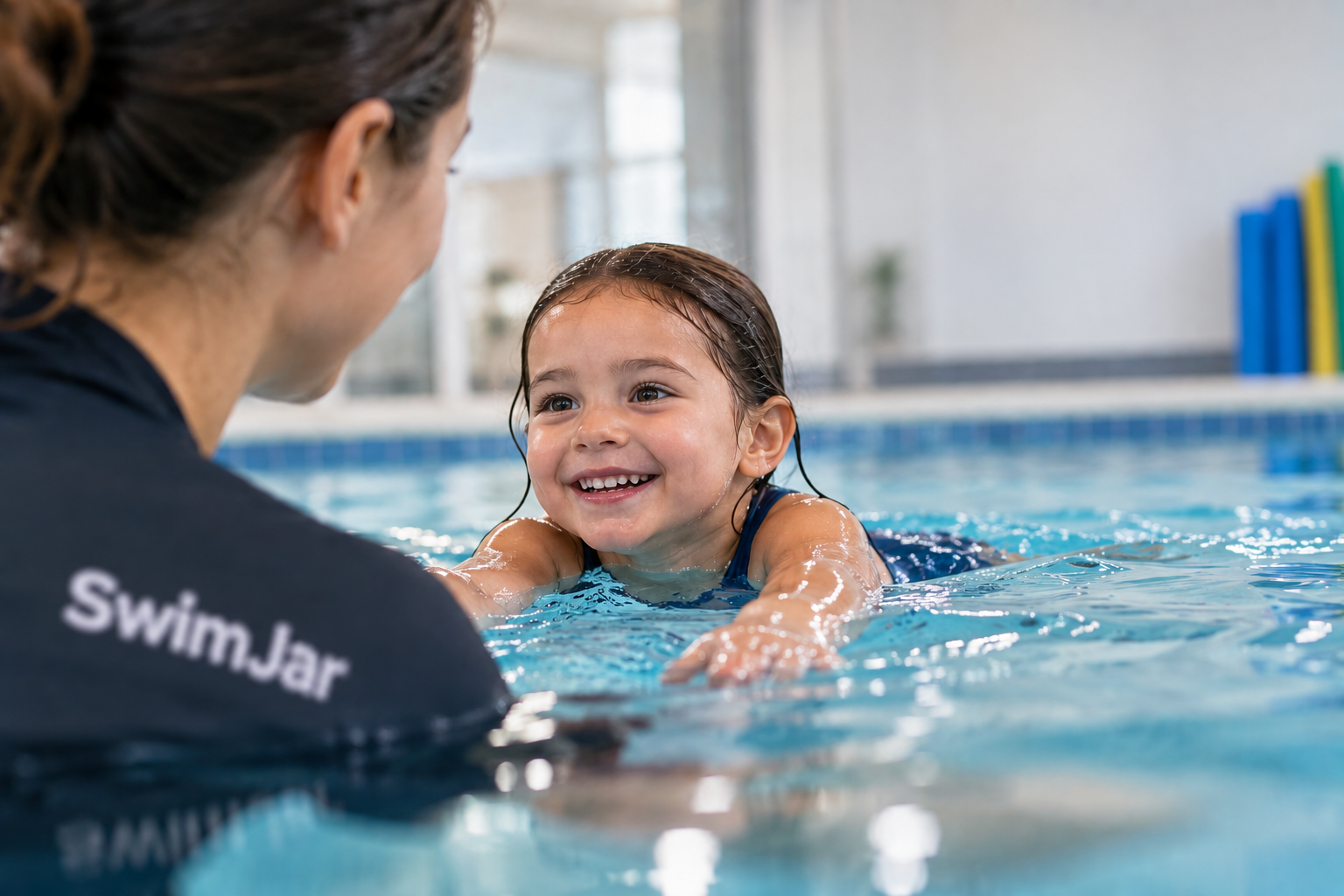
Child learning to swim without armbands during a private swimming lesson.
For many children, armbands are part of their earliest experiences of a swimming pool. They provide additional buoyancy and allow a child to move around the water before they have developed the skills to do so independently.
But when the purpose of going to the pool changes from simply being in the water to learning how to swim, an important question arises.
When should the armbands come off?
At SwimJar, our approach is straightforward: we don't rely on flotation aids to teach children to swim. The reason isn't about making lessons more difficult. It is about allowing children to learn from the water itself.
Learning to swim without floats . Water already provides buoyancy. The skill is learning how to work with it. A child needs to discover how their body balances in water, how changing the position of the head affects the rest of the body and how breathing, alignment and movement influence what happens next. These are not details to introduce once a child can already swim. They are part of learning to swim. Armbands add buoyancy around the upper arms and change the way the body is supported. A child can therefore become familiar with moving through water under conditions that will be different when the flotation aid is removed.
At SwimJar, we prefer to teach the conditions the child will ultimately swim in from the beginning.
Without artificial buoyancy.
With the teacher providing physical guidance and support when it is needed. And with that support gradually reducing as the child's own ability develops.
Moving through water isn't necessarily swimming From the side of the pool, a child wearing armbands can look remarkably independent. They may kick enthusiastically, travel several metres and happily move away from the wall. But covering distance with additional buoyancy is different from independently organising the body in water. Without that additional support, the child needs to manage balance, orientation, breathing and propulsion themselves.
Eventually, those elements have to come together within recognisable swimming technique. That is why distance alone tells us relatively little about a child's swimming ability.
At SwimJar, we are interested in what sits underneath it.
Can the child balance independently?
Can they change position?
Can they move comfortably from front to back?
Do they understand what their body does when they breathe?
Can they create propulsion without fighting the water?
Those foundations make swimming possible.
Why introduce something we later need to remove?
If the eventual objective is independent swimming without flotation aids, there is a simple logic to allowing children to learn without becoming reliant upon them in the first place. That does not mean removing support from a child who cannot yet swim. It means changing where that support comes from. During a SwimJar lesson, the teacher can guide the child's body directly. The amount of assistance can then respond to what the child actually needs. Initially, that may mean substantial physical support. As balance and coordination develop, it becomes less. A hand becomes a lighter touch. A lighter touch becomes a fingertip.
Eventually, the child no longer needs it. The important part is what happens during that progression. As the teacher's support decreases, the child's ability increases. The child isn't suddenly asked to discover independent swimming after an external flotation aid is removed. Independence has been developing throughout the learning process.
So when should children stop using armbands for swimming lessons?
We don't believe the answer should be determined by age. Children arrive at swimming lessons with different experiences, physical development and levels of aquatic ability. For teaching, the more useful question is whether a flotation aid is helping the child develop the skills they will ultimately need to swim independently. Our approach at SwimJar is that those skills are best developed through direct experience of the water. That means learning buoyancy rather than having additional buoyancy supplied. Learning balance rather than having body position determined by equipment. Learning how movement affects the water rather than simply producing enough movement to travel forwards. And learning progressively, with appropriate teaching support, until those skills genuinely belong to the child.
What replaces the armbands?
Skill.
A child learns how their body responds to water. They learn to balance and change position. They learn to control breathing without losing the organisation of their movement. They learn how their arms and legs create propulsion. They develop coordination, rhythm and body awareness. And, progressively, those foundations develop into technically sound front crawl, backstroke, breaststroke and butterfly. This process takes time.
But the objective isn't to make a child appear independent as quickly as possible. It is to develop real swimming ability. Building independence that belongs to the child. There is a significant difference between equipment allowing a child to move independently and a child possessing the skills to do so.
At SwimJar, we are interested in the second.
That is why we don't measure swimming development simply by how quickly a child can cross the pool. We look at the quality of movement, the child's understanding of their body and their ability to adapt when something changes. The aim is not simply to remove the armbands.
It is to develop a swimmer who doesn't need them to swim.
That independence cannot be taken off at the side of the pool.
It belongs to the child.