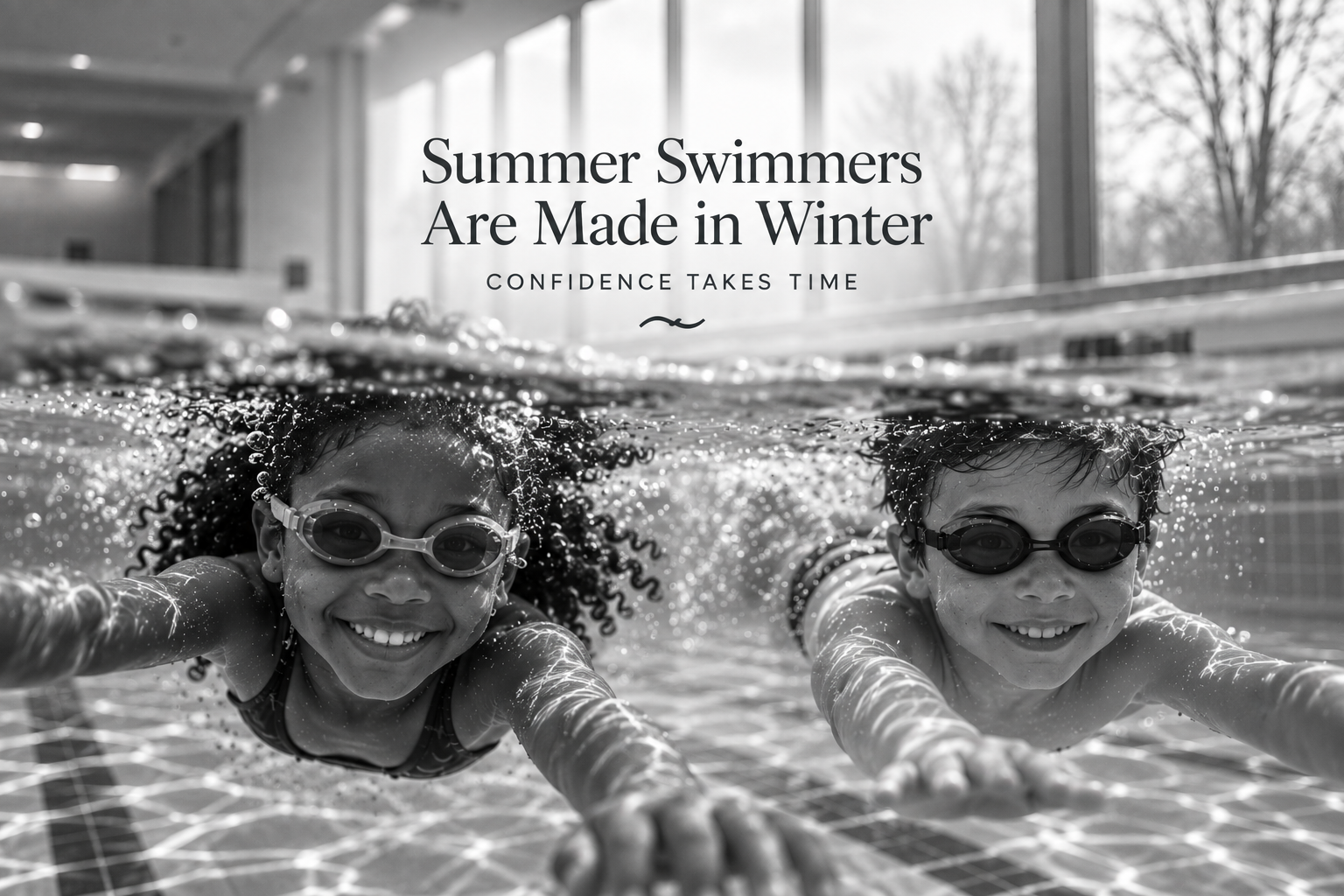
Summer Swimmers Are Made in Winter
summer-swimmers-made-in-winter-swimjar.jpg
When the days become shorter and coats come out of the cupboard, swimming isn't necessarily the first activity parents think about.
The summer holiday is over. The paddling pool has been packed away. Weekends begin to fill with school, football, dance, birthday parties and everything else that arrives with a new term.
Swimming can wait until spring. Except spring has a habit of becoming summer remarkably quickly. Suddenly, there is a holiday approaching. There is a hotel pool in the photographs, perhaps a beach nearby and the realisation that the child who happily splashed around last year still isn't quite as comfortable or independent in water as everyone hoped they would be. That is when swimming lessons can start to feel urgent.
At SwimJar, we prefer a different approach.
Summer is for enjoying the water. Winter gives children the time to learn it.
Confidence is difficult to rush
Parents often come to swimming with a perfectly understandable deadline. A holiday is six weeks away. There will be a pool. They would love their child to be more confident by then. A great deal can change in six weeks, particularly with focused teaching. But genuine confidence in water isn't something that can always be hurried into existence. Children need time to become familiar with how their bodies behave in water.
Breathing needs to settle.
Balance needs to develop.
Movements that initially require enormous concentration gradually need to become familiar. A child who once needed constant reassurance begins to discover that they can manage things independently. Those changes rarely arrive all at once. They accumulate.
One lesson makes the next lesson easier. Something introduced one week suddenly makes sense several weeks later. A movement that initially feels unfamiliar becomes something the child no longer has to think about. And underneath all of this, confidence is growing. Not because somebody keeps telling the child to be confident, but because they are repeatedly discovering:
I can do this.
That kind of confidence takes a little time. Winter gives us that time.
Learning without the holiday countdown
There is something rather nice about learning to swim when there is no immediate deadline attached to it. Nobody needs to be ‘holiday ready’ by next Tuesday.
There is room to build the foundations properly. A child can spend time developing balance rather than being hurried towards another length. Breathing can become comfortable. Coordination can develop. Technique can be introduced gradually and movements can be repeated until they begin to belong to the child.
At SwimJar, this matters. We teach children progressively across front crawl, backstroke, breaststroke and butterfly, but swimming development isn't a race to collect four recognisable strokes. It is about building the movement underneath them.
Body awareness.
Balance.
Breathing.
Coordination.
Rhythm.
Timing.
The ability to move through water without unnecessary effort. These are the things that eventually make swimming look natural. And they are much easier to develop when the objective isn't simply to produce a result before the suitcase needs packing.
What a winter of swimming can change
Imagine two versions of the first day of a summer holiday. In the first, the swimming pool becomes the place where everybody discovers what still needs work.
The water is deeper than expected. The child wants to join other children but isn't quite ready. A parent stays close. There are negotiations about armbands or staying near the steps. Nobody has done anything wrong. It simply becomes clear that being happy around a familiar pool isn't always the same as feeling capable somewhere new. Now imagine that same child arriving after months of regular swimming. They recognise how the water feels. They know how to put their face in comfortably. They understand how to breathe. They can float, change position and move with increasing control. Perhaps their strokes are still developing children's swimming always is but the environment itself is no longer such a big question. The holiday pool can simply become a pool. And instead of spending the first few days trying to learn how to manage the water, the child can start enjoying what they already know. That is a very different beginning to a holiday.
Winter swimming has another advantage
Consistency is one of the quiet ingredients in learning. Children don't necessarily need dramatic progress every week. They benefit from returning to the water often enough that the previous experience hasn't disappeared. The unfamiliar becomes familiar. Then the familiar becomes comfortable. And eventually the comfortable becomes capable. Autumn and winter provide months in which that process can happen naturally. There may be weeks when progress looks enormous and others when very little appears to change. Both can be valuable.
An experienced teacher is often watching changes that aren't immediately obvious from the side of the pool: a more balanced body position, an easier breath, better timing or the moment when a child stops waiting for an instruction and makes the adjustment themselves. These small developments are what eventually create the larger ones. The first independent width. The first length. The first recognisable stroke. The first time a child swims somewhere unfamiliar and simply gets on with it.
Swimming is a year-round skill
Perhaps part of the problem is that we naturally associate swimming with summer. Beaches. Outdoor pools. Holidays. Sunshine. But learning to swim doesn't need summer. Most children's swimming development happens indoors, away from the weather entirely. And unlike a seasonal activity, the skill doesn't disappear when the temperature drops. What a child learns in November can still be there in July. In fact, that is precisely the point. At SwimJar, we think of swimming as something children build rather than something they suddenly acquire. A strong foundation gives them somewhere to go next. Technique develops. Strokes become more efficient. Confidence becomes less dependent on familiar surroundings.
Eventually, swimming stops feeling like something the child is learning to cope with and starts becoming something they simply know how to do.
Water Ready before summer arrives
This is part of what we mean by Water Ready. It isn't about creating perfect young swimmers before the family holiday. Nor is it about turning every child into a competitive swimmer. It is about gradually developing the confidence, movement skills, body awareness and understanding that allow a child to feel increasingly capable in water. For some children, progress will come quickly. Others will need more time. Both are perfectly normal. The advantage of beginning during autumn or winter is that there is room for those differences. There is time to learn without rushing. Time to repeat. Time for technique to settle. Time for confidence to become genuine. And when summer eventually arrives, the focus can shift away from learning everything at once. The child can simply enjoy using what they have built. So perhaps the beginning of autumn isn't the end of swimming season after all. Perhaps it is the beginning of the next one.
Because the best time to start preparing a child for summer in the water isn't when the holiday is approaching.
Summer swimmers are made in winter.